AI Proctoring vs Live Proctoring
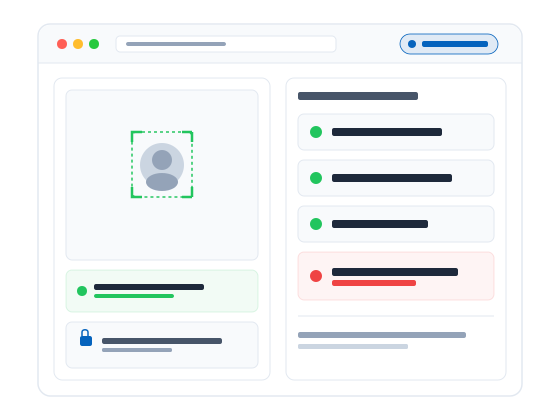
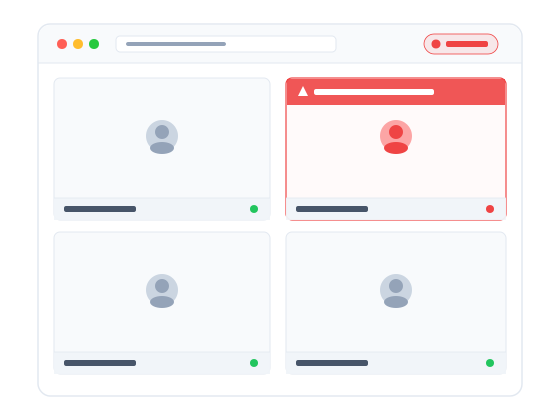
AI proctoring uses software to monitor every exam session automatically and flag integrity events for later review, while live proctoring puts a human proctor on the session in real time to watch and intervene during the attempt. AI scales across thousands of concurrent candidates at a flat per-session cost; live proctoring applies human judgement in the moment but cannot stretch across large loads. Most high-stakes programmes now blend the two.
Schedule a DemoAI Proctoring vs Live Proctoring at a Glance
The two models solve the same problem, exam integrity, with opposite trade-offs. AI proctoring optimises for scale, consistency, and cost; live proctoring optimises for context and real-time control. The table below compares them across the dimensions an exam office actually weighs before choosing.
New to the underlying methods? Start with What is AI proctoring? and What is online proctoring? for the definitions this comparison builds on.
| Dimension | AI proctoring | Live proctoring |
|---|---|---|
| How oversight works | Software watches every session and flags integrity events automatically. | A trained proctor watches feeds in real time and can intervene mid-exam. |
| Coverage per attempt | Continuous and tireless across the whole attempt. | Human attention that drifts over long shifts. |
| When review happens | After the fact: a reviewer judges only flagged moments. | In the moment: the proctor acts during the session. |
| Concurrent scale | Thousands of sessions at once with no extra staffing. | One proctor covers only a handful of candidates. |
| Context judgement | Rule and model based; can misread innocent behaviour. | Reads nuance, such as a nervous glance versus a lookup. |
| Best fit | Large, on-demand, or budget-sensitive sittings. | Small, high-stakes, or interactive exams. |
Cost and Scale: Where the Models Diverge Most
The biggest practical gap is how cost behaves as candidate numbers rise. Live proctoring cost climbs with every concurrent candidate because one proctor watches only a few feeds. AI cost tracks compute and storage, so it stays roughly flat per session and only spends human minutes on flags.
| Factor | AI proctoring | Live proctoring |
|---|---|---|
| Cost driver | Compute and storage per session, plus review time on flags only. | Proctor hours, which rise with the number of concurrent candidates. |
| Cost as volume grows | Roughly flat per session; predictable at scale. | Near-linear; more candidates means proportionally more proctors. |
| Peak-window handling | Absorbs a surge without hiring, subject to concurrency limits. | Needs surge staffing and scheduling around proctor availability. |
| Hidden overhead | A noisy model that over-flags spends reviewer minutes it should not. | Training, shift management, and fatigue-related misses. |
The catch: an over-sensitive AI that flags too much erases the saving in reviewer time, so detection accuracy matters as much as the headline per-session price. See pricing models for how flat per-session load compares with seasonal credit packs.
Accuracy: They Fail in Different Ways
Neither model is strictly more accurate. AI is consistent and never tires but can misread innocent behaviour; a live proctor understands context but loses focus over long shifts and cannot watch many feeds at once. The point is not which wins, but which failure mode you can tolerate for a given exam.
| Aspect | AI proctoring | Live proctoring |
|---|---|---|
| Consistency | Applies the same thresholds to every candidate, every time. | Varies with the proctor, the shift length, and the number of feeds. |
| Subtle repeated signals | Strong: catches patterns across a long attempt a human may miss. | Weaker over hours as attention drifts. |
| False flags | Can raise them on innocent behaviour if poorly tuned. | Rare, because context is understood in the moment. |
| Real-time intervention | Limited: mostly detects and logs, review comes later. | Direct: can pause, warn, or challenge during the exam. |
The Hybrid Model: AI Plus Live Together
Most high-stakes programmes no longer treat this as an either-or choice. A hybrid model lets AI carry the continuous watch on every candidate and surface integrity events in real time, while a human proctor stays on standby to join a session when the AI escalates a serious flag or an identity check needs a person.
This keeps live oversight where it adds the most value, on the ambiguous or high-risk moments, without paying a proctor to stare at every quiet, compliant session. ProctorLink supports both automated monitoring and live oversight in the same Moodle-based exam environment, so an institution can dial the mix per exam rather than committing to one model for everything.
- Continuous AI watch: every candidate is monitored, not a sampled few.
- Human on escalation: a proctor joins only when a flag or identity case needs judgement.
- Per-exam intensity: a licensure paper can run stricter than a course-completion quiz.
Which Model Should You Choose?
Match the model to exam volume and consequence, not to a blanket policy. The guide below maps common scenarios to the model that usually fits best.
| Scenario | Recommended model | Why |
|---|---|---|
| Large concurrent sitting (entrance grid, finals week) | AI-first with human review of flags | Live staffing cannot cover thousands of feeds at once affordably. |
| On-demand certification at volume | AI-first, hybrid on escalation | Candidates book any day; continuous AI watch scales; humans handle escalations. |
| High-stakes licensure or board exam | Live or hybrid | The cost of a disputed result outweighs the cost of a human proctor. |
| Small cohort or oral or interactive component | Live proctoring | Real-time interaction and judgement matter more than scale. |
| Budget-sensitive or high-volume course exams | AI-first | Flat per-session cost keeps large programmes viable. |
Universities weighing this for entrance grids and finals should read Online proctoring software for universities; certification bodies balancing identity proofing and scale should see Online proctoring software for certification exams.
What This Looks Like in Real Deployments
Published figures from ProctorLink deployments show how the two models play out at scale:
- Natview Foundation (NFTI) ran fellowship assessments across Nigeria on a self-service, AI-led model: 60,000 proctored sessions, 36,900 candidates, zero downtime.
- Piramal Foundation used a Moodle exam environment with live proctoring for month-long, high-touch assessment programmes.
- Training Central Solutions delivered secure BFSI recruitment assessments for a bank client with zero downtime.
Across published deployments, ProctorLink has supported more than one million proctored exam sessions (methodology note below). Broader deployment notes live on the case studies page.
What customers say on G2
Institutions evaluating proctoring tools often look for independent feedback outside vendor case studies. ProctorLink is listed on G2, where Moodle administrators and training teams share verified product reviews.
Read ProctorLink reviews on G2 →Frequently Asked Questions
Sources & references
Deployment statistics and product behaviour described in this guide link to the sources below.
- SPPU case study: PG entrance exams at scale
- RT-MSSU case study: government compliance and on-premise retention
- NFTI case study: 60,000 fellowship exam sessions
- All ProctorLink case studies
- ProctorLink Moodle proctoring plugin on moodle.org
- ProctorLink reviews on G2
- ProctorLink Standard user guide (PDF)
- Privacy policy
Explore ProctorLink
Not sure which model fits your exams? Start with a demo, pricing, and case studies across both approaches.
Schedule a Demo
See AI monitoring and live oversight in one Moodle-based environment.
View Pricing
Compare flat per-session load with credit packs for seasonal sittings.
Online Proctoring
Product page covering automated monitoring and live oversight.
Assessment Tool
Build and deliver secure exams with the monitoring mix you choose.
Case Studies
AI-led and live-proctored deployments from real institutions.
What is AI Proctoring?
How automated detection flags integrity events during the attempt.
More Proctoring Guides
What is Online Proctoring?
Online proctoring supervises remote exams via webcam and microphone inside your LMS, logging rule violations with timestamps so reviewers judge flagged cases, not every session.
What is AI Proctoring?
AI proctoring uses machine learning to automatically detect suspicious exam behaviour such as multiple faces, tab switching, and absence from the camera.
Best Moodle Proctoring Plugin
A comparison of leading Moodle proctoring plugins for universities that need native LMS integration, AI monitoring, and institution-owned data.
Online Proctoring Software for Universities
How university exam offices choose online proctoring software for entrance grids, finals, and multi-faculty calendars, including stakeholder RFPs and centre-vs-online cost tradeoffs.
Online Proctoring Software for Certification Exams
How certification bodies and training providers use online proctoring for identity proofing, item-bank protection, and defensible, audit-ready credentialing exams.
How to Prevent Cheating in Moodle Exams
Practical steps to reduce cheating in Moodle quizzes using proctoring settings, question banks, timing controls, and AI monitoring.
Moodle Proctoring Plugin Comparison
Feature-by-feature comparison of Moodle proctoring plugins covering integration, AI detection, pricing, and data storage.
Online Exam Proctoring in India
A guide to online exam proctoring for Indian universities and certification providers, including compliance, pricing in INR, and local case studies.
Proctoring SDK vs API vs LMS Plugin: Which Do You Need?
How to choose between a proctoring LMS plugin, a browser SDK, and a REST API when adding proctoring to software you already own, with a decision guide and code examples.
How to Add Proctoring to a Web Application
A step-by-step guide to adding exam proctoring to a web app you own: mint a session on your backend, run the browser SDK, and read a server-side integrity report, with code from the API reference.
What Browser-Based Proctoring Can and Cannot Detect
What browser-based proctoring can detect (tab switches, clipboard, faces, identity) and what it cannot (phones, a second monitor, a virtual machine), and why the tiering exists.
How to Add Proctoring to a React Assessment App
A step-by-step guide to adding exam proctoring to a React app: mint a session on your backend, wrap the browser SDK in a useEffect hook, handle StrictMode and token expiry, and read a server-side integrity report.
How to Add Proctoring to an Angular Exam Portal
A step-by-step guide to adding exam proctoring to an Angular app: mint a session on your backend, hold the browser SDK in an injectable service, start it in ngOnInit and tear it down in ngOnDestroy, handle NgZone and token expiry, and read a server-side integrity report.
LTI 1.3 Proctoring Integration, Explained for Developers
How LTI 1.3 connects a proctoring tool to your LMS: the OpenID Connect launch handshake, why it replaces LTI 1.1 shared secrets, how it compares to a Moodle plugin and the browser SDK, and how to read the same server-side integrity report.
Adding Proctoring to a Custom Assessment Platform
A step-by-step guide to adding exam proctoring to an assessment platform you built: map your users, exams, and attempts to a session, mint it on your backend, run the browser SDK in your exam runner, and route the server-side integrity report into your own review workflow.
Why Proctoring Runs in a Cross-Origin Iframe
Why the ProctorLink SDK mounts a cross-origin iframe enclave instead of running in your page: the camera permission binds to the enclave origin and persists across sites, the session token stays out of host-page JavaScript, and the integrity score is computed server-side.
Handling the Exam Session Lifecycle: Tab Close, Refresh, and Network Drop
How a proctored exam survives a tab close, a refresh, and a network drop without fragmenting into several reports: resume by a stable attempt_id, an offline-tolerant event queue, token-expired handling, and tearing down an SPA route change without ending the attempt.
How to Design an Exam Integrity Score
How to design a defensible exam integrity score: a server-side number from 0 to 100 with itemised, weighted penalties, where face analysis drives the verdict, browser events stay pooled and capped as reviewer context, and the score triages for human review rather than failing a candidate automatically.
Get the Right Mix of AI and Live Oversight
You do not have to choose one model for every exam. Use AI for continuous, affordable watch at scale, and bring in a human proctor where the stakes justify it. ProctorLink lets you set that balance per exam inside your own Moodle-based environment.