Online Proctoring Software for Certification Exams
Online proctoring software for certification exams is the system a credentialing body uses to verify each candidate, supervise the attempt, and keep a defensible record so the credential holds up in hiring, licensure, and audits. For certification programmes the priorities are identity proofing, item-bank protection, and long-term evidence integrity, not the calendar-peak logistics that drive university exam offices.
Schedule a DemoWhich Certification Exams Need Proctoring, and How Much?
Certification programmes issue a credential a candidate carries for years, so the buying question is not “does it watch the exam” but “does it keep the result defensible.” Match the proctoring level to what the credential permits: a regulated licence needs far more than a course-completion badge.
If you need the underlying definition first, read What is online proctoring? Universities running entrance grids and finals should use Online proctoring software for universities instead; the buying criteria there are academic-calendar driven, not credential driven.
| Certification category | Credential weight | Integrity demand | Delivery fit |
|---|---|---|---|
| Regulated licensure (finance, healthcare, safety) | Highest. A pass grants legal permission to practise. | Strong ID proofing, live oversight on standby, and long, defined evidence retention. | Fixed windows with a fresh item set per sitting and dual (AI plus live) coverage. |
| Professional certification (IT, project, quality) | High. Employers and clients rely on the badge for hiring and contracts. | ID match plus continuous AI presence checks and a reviewable flag trail. | On-demand or windowed with a rotating item pool to limit question exposure. |
| Membership and fellowship assessments | High for external credibility; often audited by partner bodies. | Verifiable identity link and retention that matches partner audit rules. | Scheduled cohorts; candidates may sit from home or workplace networks. |
| Micro-credentials and course completion | Medium. Volume is high and item banks repeat across cohorts. | Lightweight AI flags with fast review; identity check kept low-friction. | On-demand delivery with a large item pool and automated flag triage. |
Identity Proofing: The Core of Credentialing Exams
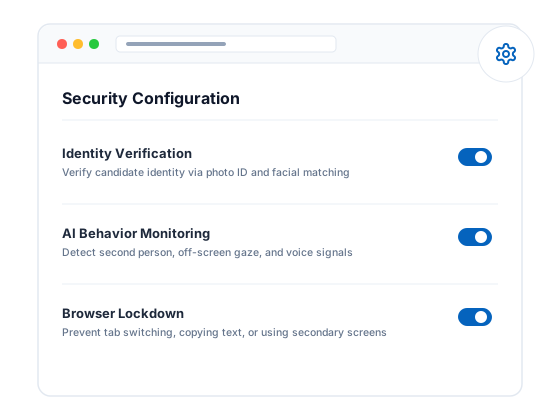
The defining risk in certification is impersonation. If the wrong person passes, the credential is worthless. Certification software should layer identity checks so the assurance level rises with the stakes, rather than a single login step.
| Proofing layer | What it checks | When to require it |
|---|---|---|
| Enrolment match | Candidate signs in against the enrolment or membership record, not a self-declared name. | Baseline for every credential; blocks casual account sharing. |
| ID document capture | Government or membership ID is captured and stored before the attempt starts. | Professional and licensure exams where the credential must map to a legal identity. |
| Live face match | The candidate face is compared to the captured ID at start. | High-stakes certification where impersonation is the main integrity risk. |
| Continuous presence | Ongoing checks confirm the verified person stays for the whole attempt. | Any credential where a substitute could take over mid-exam. |
| Secondary factor | A challenge tied to enrolment data or a proctor-confirmed room scan. | Regulated licensure and audited fellowship programmes. |
For how automated detection works during the attempt itself, see What is AI proctoring?
Fixed Windows or On-Demand Delivery?
Certification programmes must decide how candidates schedule exams, because that choice drives item-bank security more than any feature list. The table below frames the trade-off around exposure and staffing, not marketing checkboxes.
| Factor | Fixed testing windows | On-demand delivery |
|---|---|---|
| Candidate scheduling | Candidates sit on a few published dates. | Candidates book almost any day that suits them. |
| Item-bank exposure risk | Lower. A fresh item set can be used per window. | Higher. Needs a large rotating pool so questions are not repeated. |
| Staffing and support load | Concentrated; easier to surge live support for a sitting. | Spread thin; AI must carry continuous watch with on-call review. |
| Concurrency sizing | Size for peak candidates in a single window. | Size for daily peaks; steadier but never truly zero. |
| Best fit | High-stakes licensure and annual board exams. | Foundational certificates and micro-credentials at volume. |
ProctorLink runs inside a Moodle-based exam environment, so certification providers can set identity checks and per-exam monitoring intensity without a second candidate portal. See pricing models for steady on-demand load versus seasonal sittings, and product detail on the assessment tool.
Keeping a Certification Result Defensible
A credential can be challenged long after the exam. What protects a certification board is not raw video, but a chain of custody: a reviewable trail linking identity, integrity events, and the human decision behind each result.
| Chain-of-custody element | Why it matters | Keep for audit |
|---|---|---|
| Verified identity record | Proves the credential maps to a single, real candidate. | ID capture and face-match result tied to the attempt. |
| Timestamped integrity events | Shows what happened and when, not a vague summary. | Flagged stills and event logs bound to the candidate attempt. |
| Reviewer decision | Records the human judgement behind a pass, fail, or revoke. | Who reviewed each flag, the outcome, and any notes. |
| Retention and residency | Answers accreditation and data-residency questions on request. | A fixed schedule and, ideally, artefacts on infrastructure you control. |
A Launch Path for Certification Programmes
Certification exams fail online when the first live use is also the highest-stakes sitting. Sequence the launch so the programme learns its identity edge cases and false-flag rate on a controlled pilot first.
| Stage | Focus | Outcome before you proceed |
|---|---|---|
| 1. Integrity policy | Define ID proofing level, flag thresholds, and retention per credential tier. | A written rule set an accreditor or partner can review. |
| 2. Item and delivery design | Choose windows vs on-demand and size the item pool to that model. | A delivery plan that limits question exposure at your volume. |
| 3. Controlled pilot | Run one live sitting with real candidate devices and identity checks. | False-flag rate, identity edge cases, and reviewer minutes per flag. |
| 4. Scale to peak sitting | Expand only after pilot metrics meet your board thresholds. | Concurrency confirmed against the busiest single sitting. |
What Certification Deployments Look Like in Numbers
Use published figures from credentialing and training providers when you size identity load and concurrency for your own programme:
- Natview Foundation (NFTI) scaled fellowship assessments across Nigeria on a self-service model: 60,000 proctored sessions, 36,900 candidates, zero downtime.
- Training Central Solutions delivered secure BFSI recruitment assessments for a bank client independently, with zero downtime, a certification-style delivery pattern.
- Piramal Foundation replaced a broken proprietary system with a Moodle exam environment plus live proctoring for month-long assessment programmes.
These are credentialing and training-provider patterns. University exam-office criteria differ and are covered in a separate guide. Broader deployment notes live on the case studies page. Across published deployments, ProctorLink has supported more than one million proctored exam sessions (methodology note below).
What customers say on G2
Institutions evaluating proctoring tools often look for independent feedback outside vendor case studies. ProctorLink is listed on G2, where Moodle administrators and training teams share verified product reviews.
Read ProctorLink reviews on G2 →Frequently Asked Questions
Sources & references
Deployment statistics and product behaviour described in this guide link to the sources below.
- SPPU case study: PG entrance exams at scale
- RT-MSSU case study: government compliance and on-premise retention
- NFTI case study: 60,000 fellowship exam sessions
- All ProctorLink case studies
- ProctorLink Moodle proctoring plugin on moodle.org
- ProctorLink reviews on G2
- ProctorLink Standard user guide (PDF)
- Privacy policy
Explore ProctorLink
Ready to make your credentials defensible? Start with a demo, pricing, and credentialing case studies.
Schedule a Demo
Walk through identity proofing, delivery model, and retention for your certification programme.
View Pricing
Compare subscription plans for on-demand load with credit packs for seasonal sittings.
Assessment Tool
Product page for building and delivering secure credentialing exams.
Corporate Training
Certify learners and staff with proctored completion and recruitment assessments.
Case Studies
NFTI, Training Central, and Piramal: fellowship, recruitment, and long-form credentialing.
What is AI Proctoring?
How automated detection flags integrity events during the attempt.
More Proctoring Guides
What is Online Proctoring?
Online proctoring supervises remote exams via webcam and microphone inside your LMS, logging rule violations with timestamps so reviewers judge flagged cases, not every session.
What is AI Proctoring?
AI proctoring uses machine learning to automatically detect suspicious exam behaviour such as multiple faces, tab switching, and absence from the camera.
Best Moodle Proctoring Plugin
A comparison of leading Moodle proctoring plugins for universities that need native LMS integration, AI monitoring, and institution-owned data.
Online Proctoring Software for Universities
How university exam offices choose online proctoring software for entrance grids, finals, and multi-faculty calendars, including stakeholder RFPs and centre-vs-online cost tradeoffs.
AI Proctoring vs Live Proctoring
A side-by-side comparison of AI proctoring and live human proctoring for cost, scale, accuracy, and exam security.
How to Prevent Cheating in Moodle Exams
Practical steps to reduce cheating in Moodle quizzes using proctoring settings, question banks, timing controls, and AI monitoring.
Moodle Proctoring Plugin Comparison
Feature-by-feature comparison of Moodle proctoring plugins covering integration, AI detection, pricing, and data storage.
Online Exam Proctoring in India
A guide to online exam proctoring for Indian universities and certification providers, including compliance, pricing in INR, and local case studies.
Proctoring SDK vs API vs LMS Plugin: Which Do You Need?
How to choose between a proctoring LMS plugin, a browser SDK, and a REST API when adding proctoring to software you already own, with a decision guide and code examples.
How to Add Proctoring to a Web Application
A step-by-step guide to adding exam proctoring to a web app you own: mint a session on your backend, run the browser SDK, and read a server-side integrity report, with code from the API reference.
What Browser-Based Proctoring Can and Cannot Detect
What browser-based proctoring can detect (tab switches, clipboard, faces, identity) and what it cannot (phones, a second monitor, a virtual machine), and why the tiering exists.
How to Add Proctoring to a React Assessment App
A step-by-step guide to adding exam proctoring to a React app: mint a session on your backend, wrap the browser SDK in a useEffect hook, handle StrictMode and token expiry, and read a server-side integrity report.
How to Add Proctoring to an Angular Exam Portal
A step-by-step guide to adding exam proctoring to an Angular app: mint a session on your backend, hold the browser SDK in an injectable service, start it in ngOnInit and tear it down in ngOnDestroy, handle NgZone and token expiry, and read a server-side integrity report.
LTI 1.3 Proctoring Integration, Explained for Developers
How LTI 1.3 connects a proctoring tool to your LMS: the OpenID Connect launch handshake, why it replaces LTI 1.1 shared secrets, how it compares to a Moodle plugin and the browser SDK, and how to read the same server-side integrity report.
Adding Proctoring to a Custom Assessment Platform
A step-by-step guide to adding exam proctoring to an assessment platform you built: map your users, exams, and attempts to a session, mint it on your backend, run the browser SDK in your exam runner, and route the server-side integrity report into your own review workflow.
Why Proctoring Runs in a Cross-Origin Iframe
Why the ProctorLink SDK mounts a cross-origin iframe enclave instead of running in your page: the camera permission binds to the enclave origin and persists across sites, the session token stays out of host-page JavaScript, and the integrity score is computed server-side.
Handling the Exam Session Lifecycle: Tab Close, Refresh, and Network Drop
How a proctored exam survives a tab close, a refresh, and a network drop without fragmenting into several reports: resume by a stable attempt_id, an offline-tolerant event queue, token-expired handling, and tearing down an SPA route change without ending the attempt.
Make Every Credential Defensible
Start with the right identity proofing level, choose a delivery model that protects your item bank, and pilot before your highest-stakes sitting. ProctorLink supports that path for certification bodies and training providers with layered identity checks and institution-owned evidence.